
Building a Reserve for Future Roof Repair: A Guide for HOA and Condo Boards (Alliant Association Management)
Every roof in your community has an expiration date. The only question is whether your association will have the money ready when that day comes, or whether homeowners will receive a special assessment letter for thousands of dollars.
In Southwest Florida, that question arrives sooner than most HOA and condominium boards expect. Intense sun, salt air, and hurricane seasons like Ian in 2022 and Helene and Milton in 2024 shorten roof life and turn small leaks into major repairs. For communities relying on professional association management, preparing for these expenses requires proactive financial planning, regular property assessments, and a clear understanding of Florida’s reserve funding requirements.
A well-planned roof reserve fund helps solve these challenges. It spreads the cost of a future roof replacement across the years owners actually use it, supports budget compliance, and protects property values. With the right association management guidance, HOA and condo boards can develop a sustainable reserve strategy that prevents unexpected financial burdens. This guide explains how to build one, step by step.
Why Your Association Needs a Roof Reserve Fund
The roof is usually one of the largest single expenses an association will ever face. For a mid-rise condominium or a community of villas, replacement can run well into six or seven figures. Without a dedicated reserve, the board has three choices: delay the work, borrow money, or levy a special assessment.
An experienced association management company can help boards anticipate these expenses, coordinate reserve planning, and ensure that major maintenance projects are considered during the annual budgeting process.
Florida Roofs Wear Out Faster
Florida roofs generally experience shorter lifespans than national averages because of UV exposure, heat, humidity, and severe storms. For association management teams overseeing communities throughout Southwest Florida, understanding these environmental factors is essential when developing long-term maintenance and reserve plans.
Typical Florida ranges reported by local contractors:
| Roof Type | Typical Florida Lifespan | Planning Note |
|---|---|---|
| Asphalt shingle | 15–20 years | Coastal sites often fall at the low end |
| Concrete or clay tile | 25–50+ years | Underlayment usually needs replacing at 20–30 years, long before the tile |
| Metal (standing seam) | 30–50+ years | Aluminum resists salt air better than steel near the Gulf |
| Flat / low-slope (TPO, modified bitumen) | 10–25 years | Drainage and ponding drive early failure |
Ranges vary by installation quality, maintenance, and distance from the water (Roof Pack, Fox Haven Roofing, Platinum Roofing). Your reserve study, supported by professional association management and qualified specialists, should determine the actual planning figures for your buildings.
What Happens Without Reserves?
Without proper reserve planning, associations can face several financial and operational challenges:
- Special assessments. Owners may face a large bill on short notice, which can strain fixed-income and seasonal residents.
- Deferred repairs. Leaks spread into decking, insulation, ceilings, and units, increasing the final repair cost.
- Insurance and lending pressure. Older roofs can raise premiums or limit coverage, while lenders closely examine reserve health when buyers seek mortgages.
- Lower property values. Buyers increasingly ask for reserve studies and SIRS reports before making an offer.
Effective association management helps boards address these risks through proactive maintenance, responsible budgeting, and transparent communication with homeowners.
What Florida Law Requires for Roof Reserves
Florida treats condominiums and homeowners’ associations differently, making it important for boards and their association management partners to understand which statutes govern their communities. Condominiums generally follow Chapter 718, while most single-family and villa HOAs follow Chapter 720.
Understanding these requirements is an important part of professional association management, particularly when preparing annual budgets, coordinating reserve studies, and advising boards on their financial responsibilities.
Condominium Associations (Chapter 718)
The roof has long been a required reserve item for Florida condominiums, alongside painting and pavement. Since the post-Surfside reforms (SB 4-D in 2022, refined by HB 913 in 2025), the rules are much stricter for taller buildings.
Here are several important requirements that condominium boards and their association management teams should understand:
- SIRS buildings. Residential condo buildings with three or more habitable stories must have a Structural Integrity Reserve Study (SIRS) at least every 10 years. The roof is the first item the study must cover. It must be performed or verified by a Florida-licensed engineer or architect, or a CAI- or APRA-credentialed reserve specialist (Florida Senate bill text; Reserve Advisors).
- No waivers for SIRS items. Owners can no longer vote to waive, reduce, or redirect reserves for SIRS components, including the roof (Withum).
- Deadlines. HB 913 moved the initial SIRS deadline to December 31, 2025, with buildings whose milestone inspection is due by December 31, 2026, allowed to complete both together (Reserve Advisors; CSI).
- Funding options. SIRS reserves may be funded through regular assessments, special assessments, loans, or lines of credit; the last three need approval from a majority of total voting interests (Association Reserves bulletin).
- Pooling is allowed. Associations may pool reserves, but SIRS and non-SIRS reserves must be accounted for separately (Kovitz Shifrin Nesbit).
- Reserve threshold. HB 913 raised the threshold for other reserve items from $10,000 to $25,000, adjusted yearly for inflation; reserve specialists report the 2026 figure as $25,675 (FPAT). The roof is reserved regardless of this threshold.
New in October 2026
Amended DBPR Rule 61B-22.005 took effect October 4, 2026. It requires a SIRS association’s reserve funding to match its most recent completed SIRS and bars boards from altering the study’s cost or remaining-life findings. It also makes an updated SIRS mandatory if a roof replacement happens more than two years earlier or later than scheduled, and requires a site visit for any update after a storm that may affect the structure (FPAT summary; Florida Department of State).
For association management professionals and condominium boards, these changes make accurate reserve planning and ongoing compliance monitoring even more important. Further changes to this rule were noticed in September 2026, so check the current text before budgeting.
Condos without a SIRS requirement (for example, two-story buildings) still must reserve for the roof but may waive or reduce non-SIRS reserves by a majority of total voting interests, effective for one budget year only (FPAT).
Homeowners’ Associations (Chapter 720)
Unlike condominiums, HOAs are not subject to SIRS. Reserves become mandatory when the developer established them or a majority of total voting interests approved them (Florida Condo & HOA Law Blog).
Once established, they must be funded by formula unless members vote to waive or reduce them for that budget year, and reserve money can be spent only on its intended purpose without a member vote (Cooperator News).
Even when reserves are optional, an HOA that owns clubhouse, cabana, or villa roofs takes on significant special-assessment risk by skipping them. Professional association management can help HOA boards evaluate these risks, understand their financial obligations, and establish responsible long-term maintenance strategies.
This article is general information, not legal advice. Have your association attorney confirm how these rules apply to your governing documents.
Southwest Florida Factors That Change the Math
A generic reserve formula does not account for all the environmental and financial pressures roofs face from Punta Gorda to Naples. Association management teams working with Southwest Florida communities should consider these local factors when helping boards prepare their reserve budgets:
- Hurricanes and storm damage. Ian, Helene, and Milton showed how quickly roofs can fail across Lee, Charlotte, and Collier counties. Insurance may cover storm damage, but deductibles, often a percentage of insured value, come out of association funds. Many boards maintain a separate hurricane deductible reserve or line of credit alongside the roof reserve.
- Building code rules after damage. Florida’s long-standing “25% rule” required a full roof replacement when a quarter or more of a roof needed repair. Since 2022, roofs built to the 2007 Florida Building Code or later need only the damaged section brought up to current code; older roofs may still trigger full replacement (Jimerson Birr; Citizens job aid). An older roof carries more financial risk after a storm.
- Insurance underwriting. Carriers look closely at roof age and condition. A roof near the end of its life can mean higher premiums or narrower coverage, so a funded replacement plan can also help protect insurance options.
- Salt air and sun. Gulf-front and barrier island communities such as Sanibel and Fort Myers Beach experience faster corrosion of fasteners, flashing, and metal components.
- Aging buildings. Many Southwest Florida condominiums were built in the 1970s and 1980s. These buildings often face roof, milestone inspection, and structural repairs within the same window, competing for the same owner dollars.
- Contractor demand after storms. Prices and wait times rise sharply after a major hurricane. Adequate reserves allow boards to sign contracts quickly instead of waiting for financing.
A proactive association management approach helps boards account for these local conditions before they become expensive emergencies.
How to Build Your Roof Reserve Fund: 7 Steps
Developing a sustainable roof reserve fund requires coordination between the board, financial professionals, reserve specialists, contractors, and the association management team. Here are seven practical steps to get started.
1. Start With a Professional Reserve Study
A reserve study inventories each roof, estimates its remaining useful life and replacement cost, and establishes an annual contribution. For SIRS buildings, it is required; for HOAs and low-rise condominiums, it remains the best foundation for a defensible budget.
Your association management company can help coordinate the reserve study process, communicate with qualified specialists, and ensure the findings are considered during annual budget preparation. Update the study regularly and after any major storm.
2. Get a Roof Condition Assessment
Ask a licensed roofing contractor or engineer to inspect each roof section.
Document the material, age, underlayment condition, drainage, and any storm damage. This turns a textbook lifespan into a realistic estimate for your specific property. Association management teams can coordinate inspections and help ensure the board receives the information needed to make informed maintenance decisions.
3. Separate Roofs by Building and Type
A clubhouse shingle roof, a tile roof on the villas, and a flat roof on a mid-rise condominium will wear out on different schedules.
List each one as its own reserve component so funding matches reality. This level of detail allows association management professionals and boards to plan maintenance and replacement schedules more accurately across multiple buildings.
4. Calculate the Annual Contribution
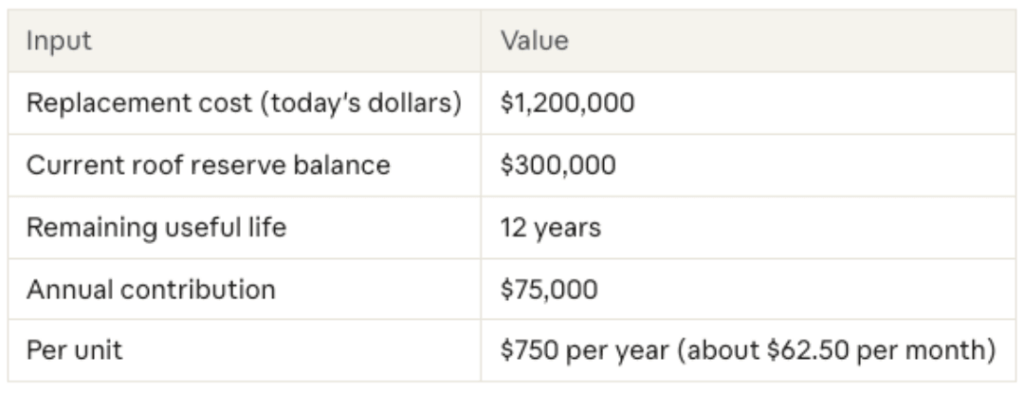
The basic straight-line formula spreads what you still need over the years you have left:
Annual contribution = (Replacement cost − Current reserve balance) ÷ Remaining useful life (years)
Example (illustrative): A 100-unit condominium with one roof.
5. Choose Straight-Line or Pooled Funding
Straight-line funding reserves for each roof individually. Pooled (cash-flow) funding combines components into one account and plans so the balance never drops below zero.
Pooling can smooth contributions for communities with several roofs, but Florida condominiums must follow the funding method requirements in their statute and Rule 61B-22.005. An experienced association management team can help boards understand the practical budgeting implications and coordinate with their reserve specialists and financial advisors.
6. Fund Consistently and Protect the Account
Budget the contribution every year, deposit it on schedule into a separate reserve account, and keep it restricted to its intended purpose.
Consistent funding is one of the most important responsibilities of effective association management. Small, steady increases are generally easier for owners to manage than a single large special assessment.
7. Maintain the Roof to Extend Its Life
Routine inspections, gutter and drain cleaning, and prompt leak repairs can extend roof life and delay replacement.
Association management plays an important role in coordinating preventive maintenance, communicating with vendors, tracking repair schedules, and ensuring that reported problems receive attention. Every additional year of roof life can reduce financial pressure on the association and help protect its reserve funds.
Common Roof Reserve Mistakes to Avoid
Even associations with reserve accounts can experience funding problems when planning and maintenance are not properly coordinated. Here are common mistakes that HOA and condo boards should avoid:
- Using national lifespans. A 30-year shingle rarely lasts 30 years on the Gulf Coast. Plan with Florida-specific numbers from an on-site assessment.
- Forgetting the underlayment. Tile can outlast the membrane beneath it. Budget for re-underlayment, not just tile.
- Ignoring inflation. A reserve built on today’s price will fall short when the roof is due.
- Treating insurance as the plan. Policies do not pay for normal wear, and hurricane deductibles can be large.
- Borrowing from the roof reserve. Using reserve funds for operating shortfalls is restricted by law and leaves the roof unfunded.
- Letting the study go stale. After a storm, a repair, or a schedule change, update the study. For SIRS condominiums, schedule changes of more than two years now trigger a required update.
- Poor communication. Owners are more likely to understand and accept steady increases when the board explains the roof’s age, replacement cost, and timeline.
Strong association management helps prevent these mistakes by keeping financial planning, maintenance coordination, and homeowner communication connected.
Plan for the Roof Before It Plans for You
A roof replacement is one of the most predictable large expenses an association will face. The cost is known within a range, and the timeline is known within a few years. A roof reserve fund built on a current reserve study, Florida-specific lifespans, and consistent annual contributions turns that expense from a crisis into a manageable budget item.
For Florida condominiums, proper structural reserve funding is also a legal requirement. For HOAs, it is one of the most effective ways to protect owners from unexpected assessments and maintain the community’s appeal to buyers and insurers.
Ultimately, effective association management is about helping boards make informed decisions before problems arise. From coordinating professional inspections and reserve studies to overseeing maintenance schedules and financial planning, the right management partner helps communities prepare for major expenses with greater confidence.
Is Your Roof Reserve on Track?
Your community deserves more than reactive maintenance and last-minute financial decisions. With experienced association management, your board can take a proactive approach to reserve planning, protect property values, and prepare for the future.
Request a management proposal from Alliant Association Management to discuss your community’s management needs and reserve planning priorities today.